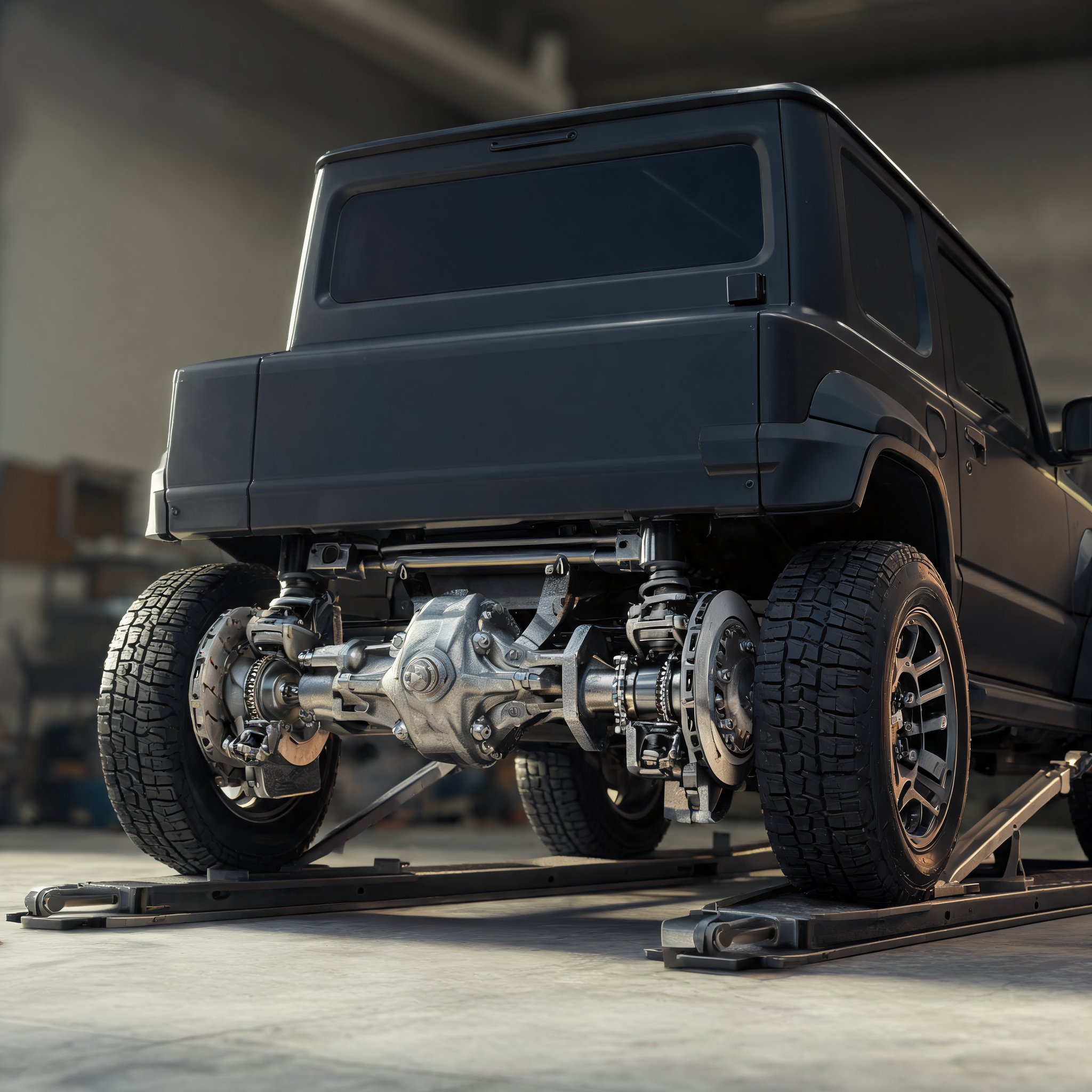
Zeph Gage has built a rear-only portal axle for his Jeep XJ by turning a Ford 9-inch differential upside down and combining it with military-derived geared hubs. The conversion is notable for its cost: where a typical set of portal axles runs about $20,000, Gage’s setup costs roughly one-fifth of that.
A flipped differential and Humvee-derived hubs
Portal axles place a stack of gears behind each driven wheel, allowing the axle shafts to sit higher and reducing the hardware that hangs below the frame. They are prized in hardcore off-roading for the clearance they create, but conventional sets are expensive. Gage’s version uses a Ford 9-inch axle housing, geared hubs from a Humvee, and a set of Jesse Haines Fabrication HMMWV portal adapters.
Two-gear portals such as the Humvee units reverse the rotation of the input shaft, which is why the differential cannot simply be mounted in its usual orientation. To correct the direction of the driveline, Gage flipped the Ford 9-inch differential upside down. A Yukon Gear and Axle third member is then bolted to the differential, in effect creating a budget high-pinion unit from low-pinion parts that have simply been inverted.
Clearance without giving up shock travel
The arrangement adds about six inches of clearance. It also retains full shock travel, a difficult goal with portal axles, and is intended to reduce stress on the differential itself. The conversion therefore aims to deliver the clearance benefit without the suspension penalties that can come with a taller lift. The design still relies on substantial custom work rather than off-the-shelf parts.
Gage installed the portal only at the rear. That choice follows a common approach in remote-control rock crawling: keeping the front solid axle avoids the packaging constraints that can arise when adding portal axles to a vehicle that never had them from the factory. It also allows the suspension to keep its shock travel and prevents the ride height from rising excessively.
Custom brackets, brakes and packaging
The conversion is not a bolt-on kit. Gage fabricated homemade brackets and custom-tapped plates, and he used a two-piece brake rotor paired with a Ford Fusion caliper. The Fusion hardware was chosen partly because it incorporates an integrated electric emergency-brake solenoid, and partly for clearance.
The finished Jeep XJ can drive over a five-gallon bucket and still have several inches of spare clearance. That means the rear end is less likely to catch on obstacles that the front end can steer around. The project shows how a rear-only portal axle can add capability at a fraction of the usual cost, but it also underscores the fabrication and parts-matching work required.