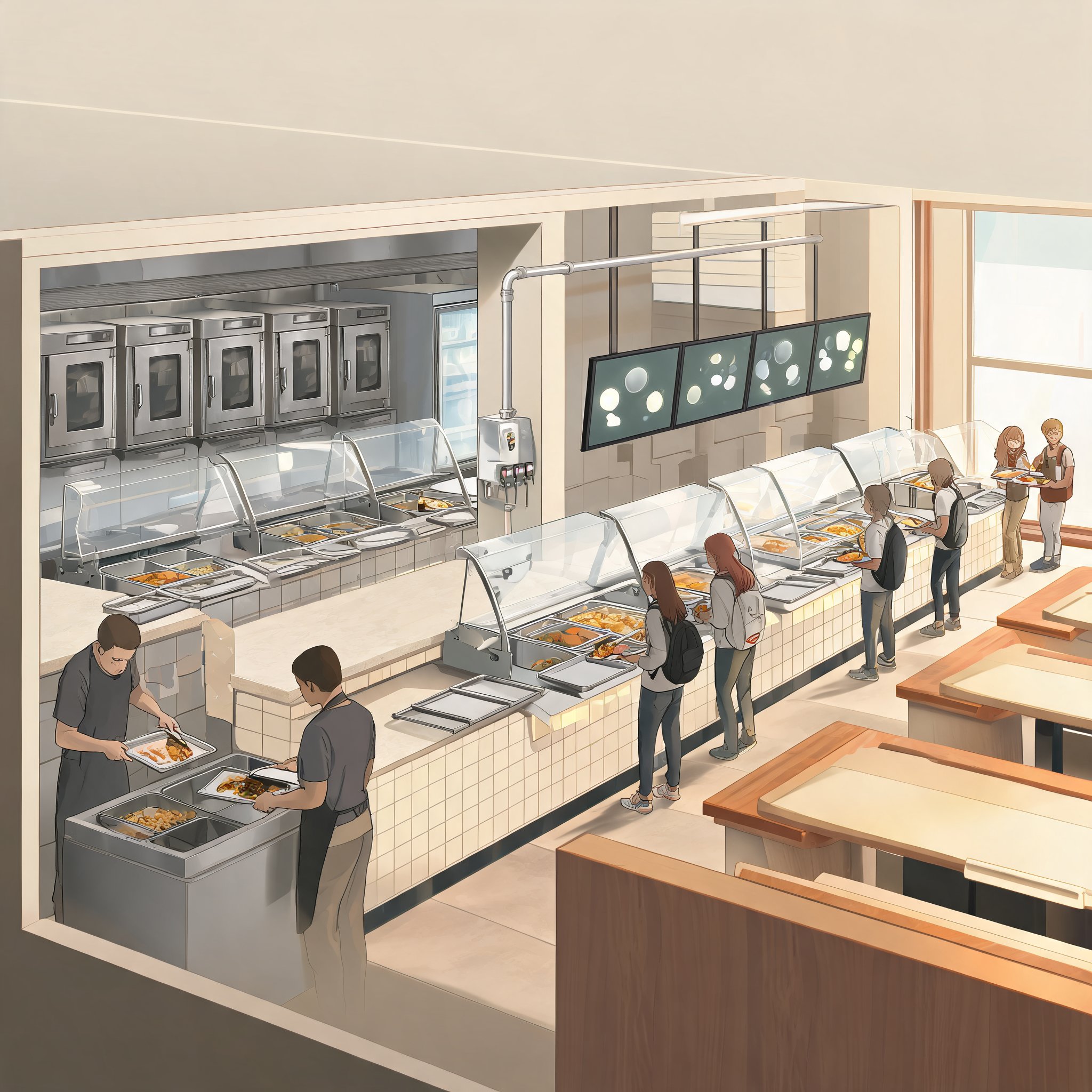
K-12 school kitchen design is moving toward more varied, made-to-order foodservice, with high school dining increasingly taking cues from college campuses and middle school operations adopting features that were once typical of high schools, according to Eric Goodrich, a principal partner at Minneapolis-based foodservice design and consulting firm Rippe Associates. Technology, sustainability and efficiency are shaping the latest plans as districts work within tight labor and space constraints.
Flexibility at the serving line
Goodrich said operators are seeking serving lines that can switch between hot and cold holding and food shields that move between full-service and self-service positions. A station might have staff serving the entree while students serve their own toppings; tilting shields can support both modes and speed service. The same setup can help when a meal period is short-staffed, allowing a full-service station to become self-service quickly.
Digital menu boards give operators room to revise menus and show changes at each station. Goodrich said students who know what is available before entering the line tend to move through faster. Clearer labeling also supports neurodivergent students by helping them make decisions quickly, he added.
Multitasking equipment
With limited space and staff, districts are looking for equipment that can perform several jobs. Goodrich described a push for more cooking capacity per square foot. Combi ovens have been common in K-12 for some time, and more districts are moving toward blast chilling, he said. Goodrich noted that RATIONAL's iCombi Pro supports cook-chill work and that the iVario can replace frying pans, deep fryers and stoves; larger models can also replace kettles and tilting skillets.
Combi ovens appeal because one unit can replace two or three pieces of equipment and can improve consistency, Goodrich said. Preprogrammed settings let staff select a product with a single button rather than manage time and temperature manually. Self-cleaning features save time, and the ability to add humidity can improve yields by reducing drying, he said.
Waste, workflow and two-handed tasks
School kitchen plans are also reflecting sustainability goals. Goodrich said districts are using fewer disposals and showing more interest in composting. He also sees more equipment intended to cut packaging waste, including milk-dispensing systems. In some designs, milk is stored in a walk-in cooler and routed to the front of the house through lines, making service easier for staff.
Workflow choices aim to reduce steps. Recirculating trough systems allow staff to scrape trays with both hands instead of holding a spray rinse in one hand, Goodrich said. Designers look for ways to let workers use two hands because, he said, that can feel almost like doubling their speed.
A less institutional dining experience
Student-facing areas are moving away from an institutional look, with demand for more polished finishes and a residential character. Stone countertops and tray slides, tile fronts on serving lines and adequate display lighting are among the high-impact choices Goodrich cited.
Operators are also more open to open kitchen designs, he said. Instead of separating the kitchen and serving area with a wall, some projects remove that barrier to gain square footage and shape a better student experience. The kitchen becomes part of the dining environment rather than a hidden back-of-house zone.
Vendor warranty offer
RATIONAL has a program for K-12 operators that adds a free year to the warranty on its iCombi Pro and iCombi Classic models. Launched in August, the offer extends the standard two-year warranty by 12 months at no charge to the school or district, according to the company.