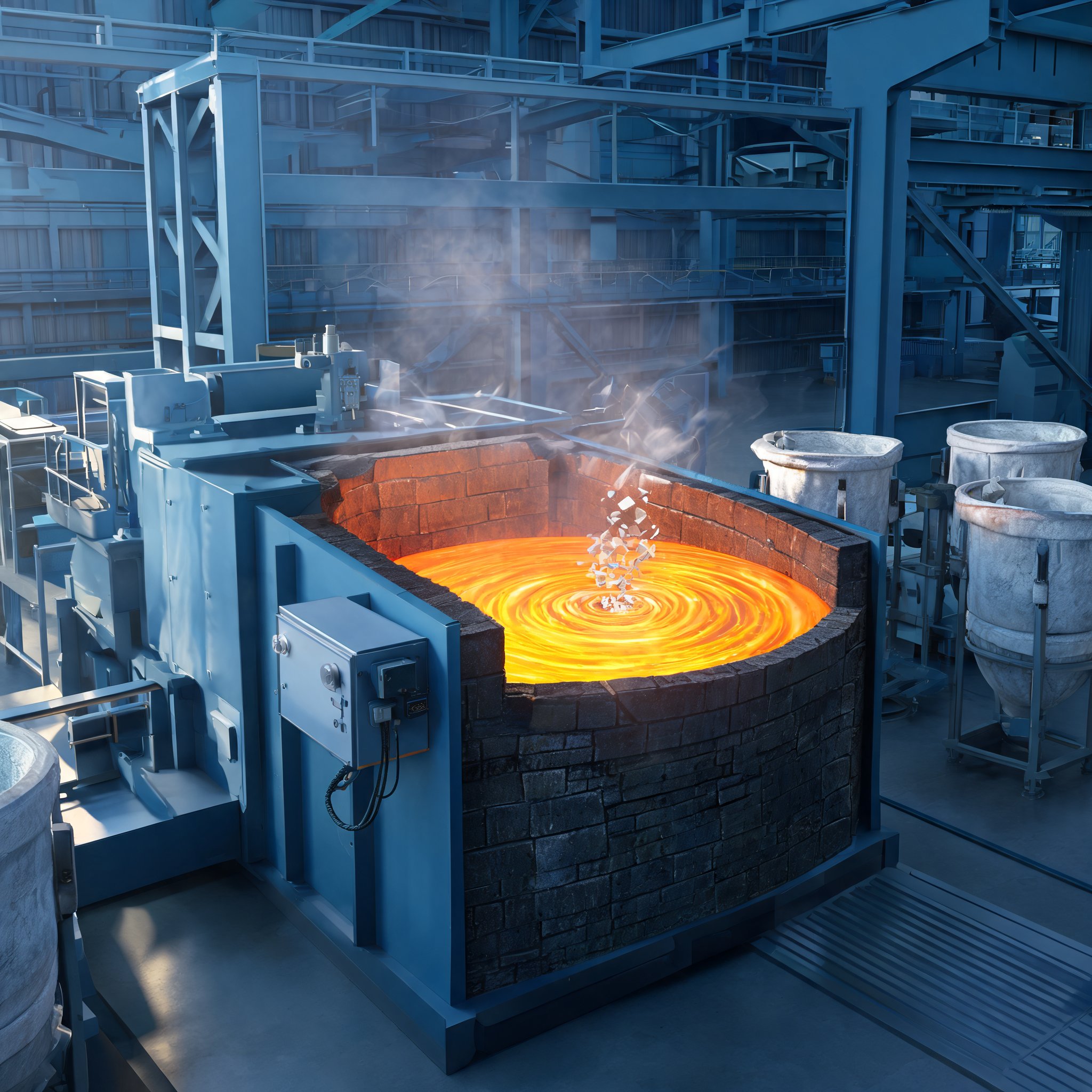
Aluminum casthouses are under pressure to consume more post-consumer scrap without sacrificing melt quality, recovery or throughput. Lightweight scrap, machining chips and low-density fractions are difficult to feed into conventional furnaces, while temperature and composition must remain uniform across the bath. Zmag America is positioning permanent-magnet circuits as an alternative to immersed mechanical components for stirring, circulation and scrap submergence.
The company’s zPMC technology uses a permanent magnetic circuit, rather than a conventional electromagnetic stirring arrangement, to generate the field that moves molten aluminum. Zmag describes the resulting flow as a virtual impeller: circulation is produced without an immersed mechanical impeller. The approach is intended to reduce exposure to molten metal, dross and refractory debris, which can degrade rotating parts.
Stirring without contact
MagStir is a non-contact stirring system for melting and holding furnaces. Zmag offers configurations for furnaces from 15 to 200 metric tons. By removing the immersed stirring element, the system is presented as a way to homogenize temperature and alloy composition without adding moving parts to the molten-metal environment.
Outside the United States, New Zealand Aluminium Smelters installed MagStir in a casting furnace and later extended it to other furnaces. A 2017 technical case study reported better temperature control during furnace preparation. Rio Tinto’s Boyne Smelters in Queensland, Australia, fitted a MagStir unit to a casthouse furnace in 2019.
Pumping and scrap submergence
MagPump applies the same magnetic approach to molten-metal pumping. It is designed to fit a standard pump well without furnace modification and, unlike a mechanical pump, has no physical impeller. Zmag markets it as a nearly hands-free option with no consumable parts and minimal downtime.
At the TANDEM division of TST Inc. in Fontana, California, a seven-week trial replaced an existing mechanical pump. The account describes smooth operation and less disturbance of the metal surface. Plant management also reported that the system avoided the splashing seen with conventional pumping as the furnace metal level dropped during draining. At TMS 2023, its use in side-well, multi-chamber furnaces was discussed, along with potential roles in gas injection and scrap submergence.
Typhoon addresses a different bottleneck: introducing lightweight scrap and chips beneath the bath surface. Its magnetic circuit creates a vortex that draws material into the melt, supporting heat exchange and recovery. At Neuman Aluminium’s Marktl facility in Austria, the system was included in a furnace modernization aimed at low-density post-consumer scrap, including fractions with a bulk density of about 375 kg/m³.
Neuman set a target of processing one metric ton per hour while continuing to melt solid charge in the same furnace. According to the published account, Typhoon processed almost twice the planned scrap quantity within the expected time without disrupting normal operations. Operator involvement was low, and the company reported no negative effect on melt or finished-product quality. Typhoon operates at 5–15 kW, including its air-cooling blower, and can submerge up to five metric tons per hour of machining chips; vortex intensity is adjustable.
A competitive field
Zmag is not alone in supplying casthouse circulation and scrap-submergence equipment. ABB’s AL-EMS electromagnetic stirring system has more than 430 installations, and in April 2026 ABB announced an order from Arconic for a fifth stirrer at a Hungarian casthouse. Presezzi Extrusion Group offers the L.E.C. stirrer for melting and holding furnaces. Pyrotek supplies electromagnetic pump systems and LOTUSS scrap submergence, while Rockwell Automation works in adjacent furnace and ladle-shop controls rather than permanent-magnet stirring.
As casthouses take on more difficult recycled feedstock, equipment that can move molten metal without immersed mechanical parts may become more relevant. The evidence so far comes from selected trials and installations; broader adoption will depend on how operators weigh familiarity, performance and site-specific integration.