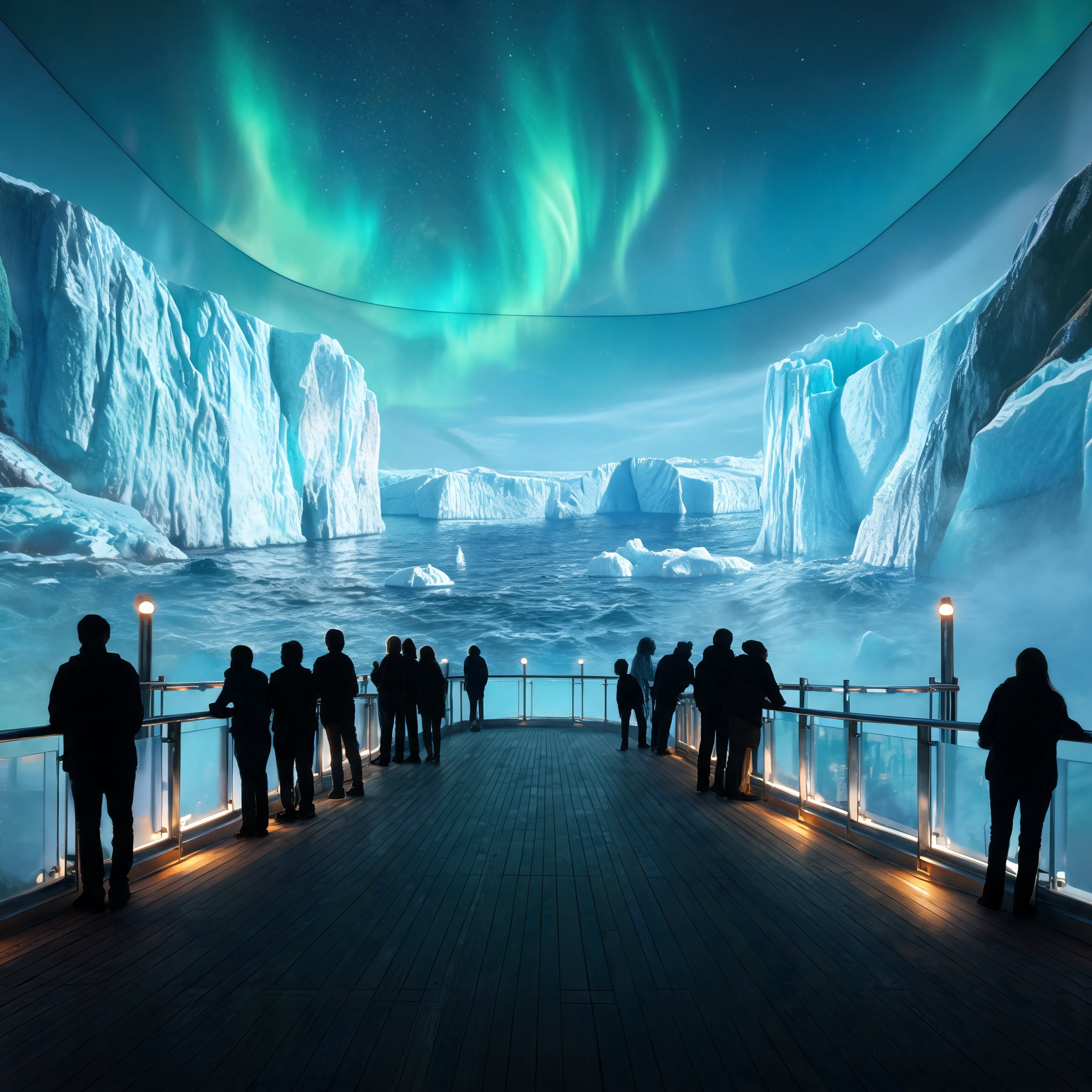
POLAR EXPERIENCE, an immersive exhibition focused on the Arctic and Antarctic, is designed to turn visitors into members of a contemporary polar expedition rather than passive spectators. The project was conceived by Nicole Srock.Stanley and developed by dan pearlman, with the Alfred Wegener Institute, Helmholtz Centre for Polar and Marine Research, as scientific partner and polar researcher Prof. Dr. Markus Rex among its contributors. It is presented by Galileo and Galileo Kids.
The exhibition combines scientific research, cinematic storytelling and multisensory design. According to the project, scientific accuracy is the basis of the visitor journey, not an added content layer. Every story, environment and installation is intended to translate complex climate knowledge into an accessible and memorable experience for audiences of different ages.
A journey from the Polarstern into the ice
The visit is structured as a continuous expedition. It begins with visitors boarding the research vessel Polarstern as expedition members and then moving into the frozen landscapes of the Arctic and Antarctic. Along the route, they encounter ice formations, polar wildlife, the lives of Indigenous communities and scientific missions that have shaped understanding of climate change. The journey ends in a 360-degree projection environment that combines large-scale visuals, surround sound and choreographed storytelling.
The project deliberately avoids fear-based messaging. Instead, it aims to build curiosity, wonder and optimism, with a final “Act Now” area that presents practical ways to engage with climate protection, partnerships and personal contribution. The stated goal is for visitors to leave with new knowledge as well as a stronger sense of responsibility and agency.
Accessibility and interdisciplinary work
Accessibility is another central design element. The exhibition is intended for families, school groups and adults with different levels of prior knowledge. A multilingual audio guide accompanies the full journey, while younger visitors are guided by Cosmo, a character from Galileo Kids, to make scientific topics understandable without simplifying the content beyond recognition.
The development process brought together scientists, filmmakers, Indigenous representatives, educators, media partners, creative designers and immersive technology specialists. Scientific expertise was involved from the earliest stages rather than being added after the creative concept was complete. Partners include WWF Germany as an NGO contributor, FKP Scorpio Entertainment as local promoter in Oberhausen, Cofo Entertainment as local promoter in Berlin, Seven.One Starwatch as media partner and GLS Bank as sponsor.
During its world premiere in Berlin, POLAR EXPERIENCE welcomed more than 120,000 visitors in four months, according to the project. It also reports praise from audiences and media. The organizers present the exhibition as a new benchmark for immersive experiences, arguing that innovation should be measured not only by technical sophistication but by the ability to connect people emotionally with global challenges.