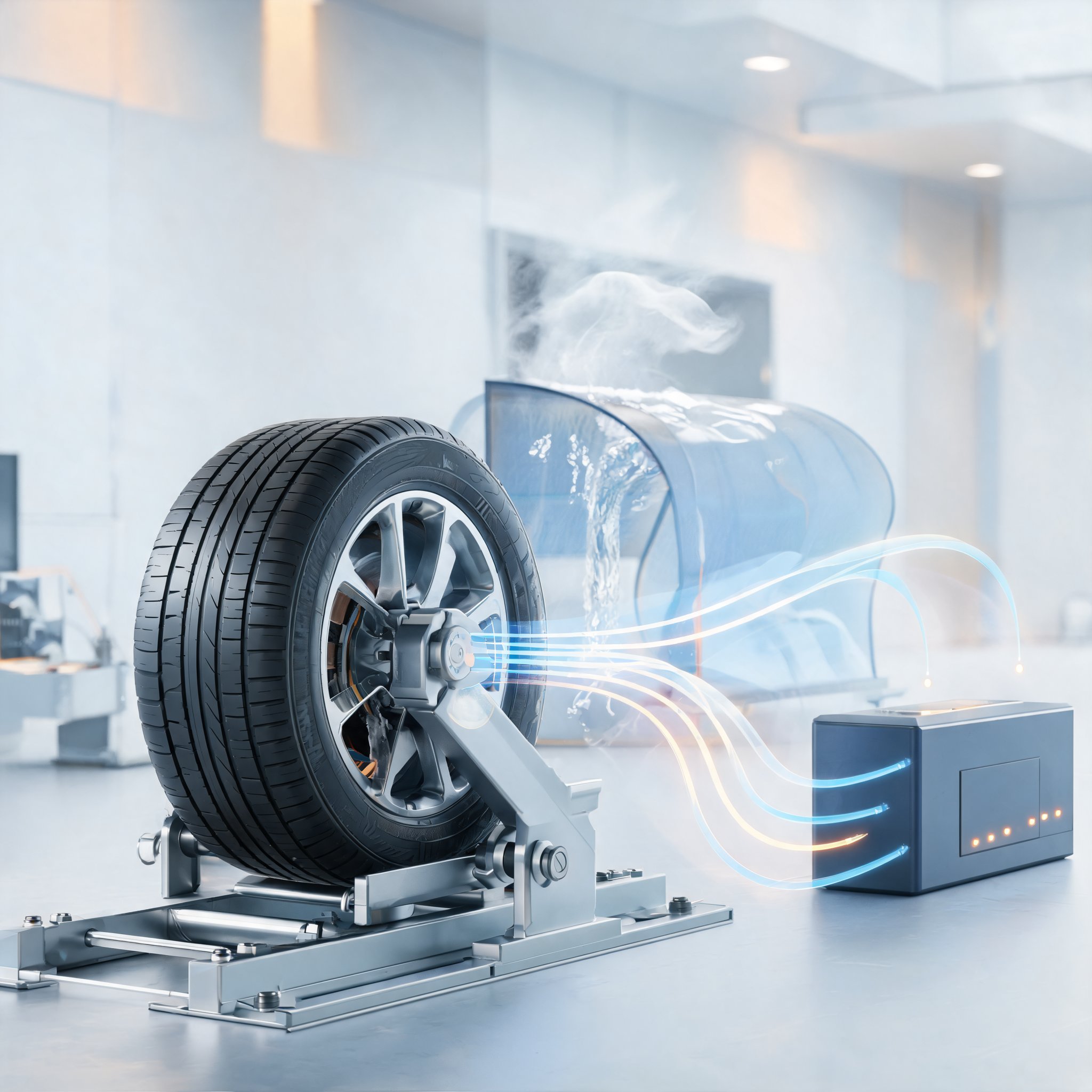
Michelin has inaugurated a joint research laboratory with four academic partners in France, setting up a four-year programme that combines data analysis, mathematical modelling and experimentation around tire technology, manufacturing processes and flexible composites.
The partnership, named I-TireLab, brings the tire maker together with the University of Poitiers, Grenoble Alpes University, Grenoble INP – UGA and the French National Centre for Scientific Research (CNRS). Announced on Nov. 4, the project represents a total investment of approximately €4.5 million over four years.
Michelin said the initiative is meant to strengthen collaboration between academic research and industrial application. The work is organised around four research areas.
Four research areas
- Tire condition monitoring. Researchers aim to deliver real-time estimates of tire wear and grip using data from sensors already fitted to vehicles, so that condition can be assessed without additional specialised equipment.
- Vehicle control integration. Teams plan to study how tire condition and grip information can be incorporated into vehicle control systems, with the objective of optimising braking performance and improving vehicle stability and efficiency.
- Rubber manufacturing. Simulation and control tools are being developed to help manufacturers plan equipment operations and optimise production settings while keeping rubber quality consistent and reducing raw material waste and energy consumption.
- Flexible materials. The fourth area will examine how flexible materials influence air and water flows around objects, and will develop control methods that change the shape of components to modify the surrounding flows.
Industrial access and planned applications
I-TireLab will give researchers access to industrial facilities, demonstrators and testing environments so that their methods can be evaluated under near-real-world conditions. Michelin said findings could eventually contribute to future innovation projects.
One planned application is Michelin Touch Intelligence, a tire digital twin the company introduced in May 2026. The technology combines vehicle sensor data with Michelin models to estimate tire pressure, wear, load and grip in real time without requiring additional sensors, and is designed to work across vehicle brands and models.
Research into flexible composites could also support Wisamo, Michelin's inflatable and retractable automated wingsail for ships, which uses wind to supplement vessel propulsion and reduce fuel consumption. According to the company, its first sail is currently in the delivery phase.
Division of work
Philippe Jacquin, Michelin's general manager and director of research and development, said the partnership would help translate scientific research into practical innovations involving tires, manufacturing and tire-vehicle interactions.
Michelin will contribute its expertise in tire simulation, materials, industrial processes and product-use data, while the academic partners will provide theoretical and methodological expertise to develop and validate new approaches. The collaboration will also support the training of young researchers working across fundamental research, experimentation and industrial applications.
Guillaume Mercère, director of I-TireLab, and co-directors John Martinez-Molina and Thibault Dairay said the initiative would bring researchers, engineers and young scientists together to improve mobility safety, manufacturing processes and flexible-material applications. The laboratory builds on existing collaboration between Michelin and the academic research teams and establishes a longer-term framework for converting data into knowledge and practical solutions.