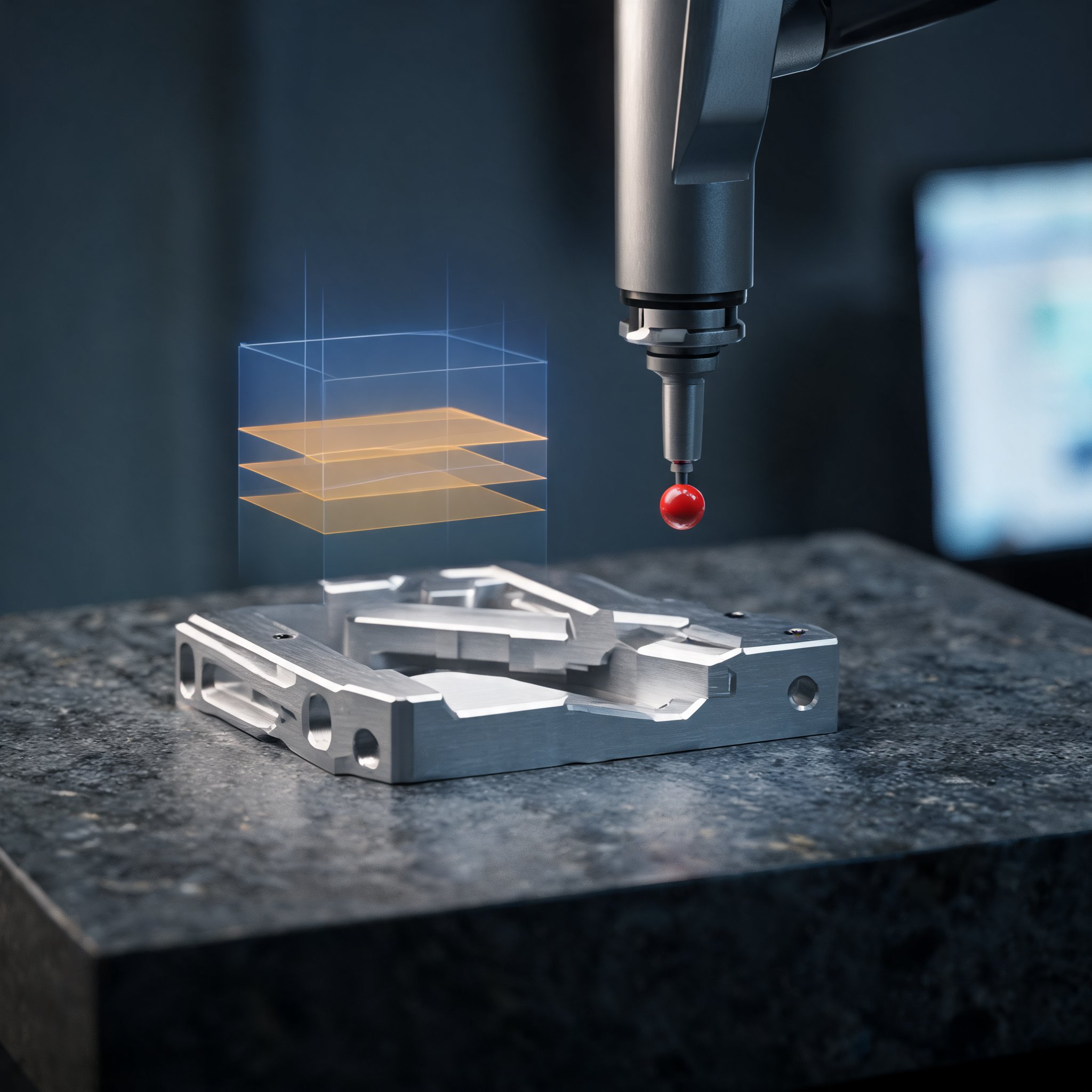
Geometric Dimensioning and Tolerancing (GD&T) acts as the shared language between design, production and metrology. Applied consistently, it is what allows a part to assemble and function as intended; misread, it produces conflicting measurement results, scrap and repeated exchanges between teams. Metrologic DCS argues that the risk is growing as Product Manufacturing Information (PMI) is embedded in more CAD files and as standards continue to change. In a published set of recommendations, the company sets out four practices intended to make GD&T workflows more reliable, from reading design intent through to the reports delivered to the shop floor.
Decode PMI instead of re-keying tolerances
The first recommendation is to begin with the PMI itself. Using PMI requires interpreting design intent: which feature is targeted, which references apply and which tolerance is specified. Done manually, the company says, this step is error-prone. One value copied incorrectly or one reference misread, and the part is inspected against a requirement that was never specified. Metrologic DCS advises software that takes PMI as its starting point, so that features and their evaluations are generated from the part's digital definition instead of being entered again by hand. The claimed result is fewer interpretation gaps and time saved at the very start of program preparation.
Automate the datum reference frame
Second, the company argues against rebuilding Datum Reference Frames (DRFs) manually. A DRF, built from reference features A, B and C, establishes where measurement begins and which degrees of freedom are constrained during evaluation. If the order is wrong, or the degrees of freedom are poorly chosen, the same part can be declared conforming or non-conforming depending on the operator, which Metrologic DCS describes as a major source of GD&T misinterpretation. Automating the step, so that the DRF and its degrees of freedom follow the drawing definition rather than operator choice, is presented as the way to make results repeatable from one operator, one machine and one site to the next. In the company's Metrolog software, the DRF is created automatically when a GD&T is evaluated, with the degrees of freedom selected accordingly.
Reuse the references already held in the CAD model
Third, Metrologic DCS recommends reusing imported DRFs. References A, B and C already carry labels placed by the design office in the CAD model; recreating them during program preparation consumes time, opens the door to discrepancies, and forces rework whenever the definition changes. On parts with many annotations, the company adds, it is also difficult to track which annotations have already been handled and which remain to be measured. Starting from PMI-derived DRFs and predefining GD&T from them is offered as the remedy, together with a clear view of where each annotation sits on the part and where its measurement stands. The company's Scan GDT function reads the decoded PMI and assigns a status so that both the decoding and the measurement can be validated.
Reports that tell the shop floor what to correct
Finally, the company addresses reporting. A report limited to 'pass' or 'fail' does not tell the shop floor what to do, Metrologic DCS contends: an operator who cannot identify the kind of defect being dealt with adjusts by trial and error, generating scrap and repeated correction loops. The recommendation is to tailor the output to its reader, whether that is a table of numerical values for quality control, a go/no-go report for a quick decision, or a decomposition analysis for the operator. In Metrolog, the defect of an evaluated feature is split into four independent types (form, size, position and orientation) alongside the global defect, so that the dominant type, and therefore the first correction to make, is visible immediately.
The four points describe a workflow design rather than measured outcomes. The time savings, cross-site repeatability and scrap reductions cited are the supplier's stated rationale for its own software, not independently verified results.