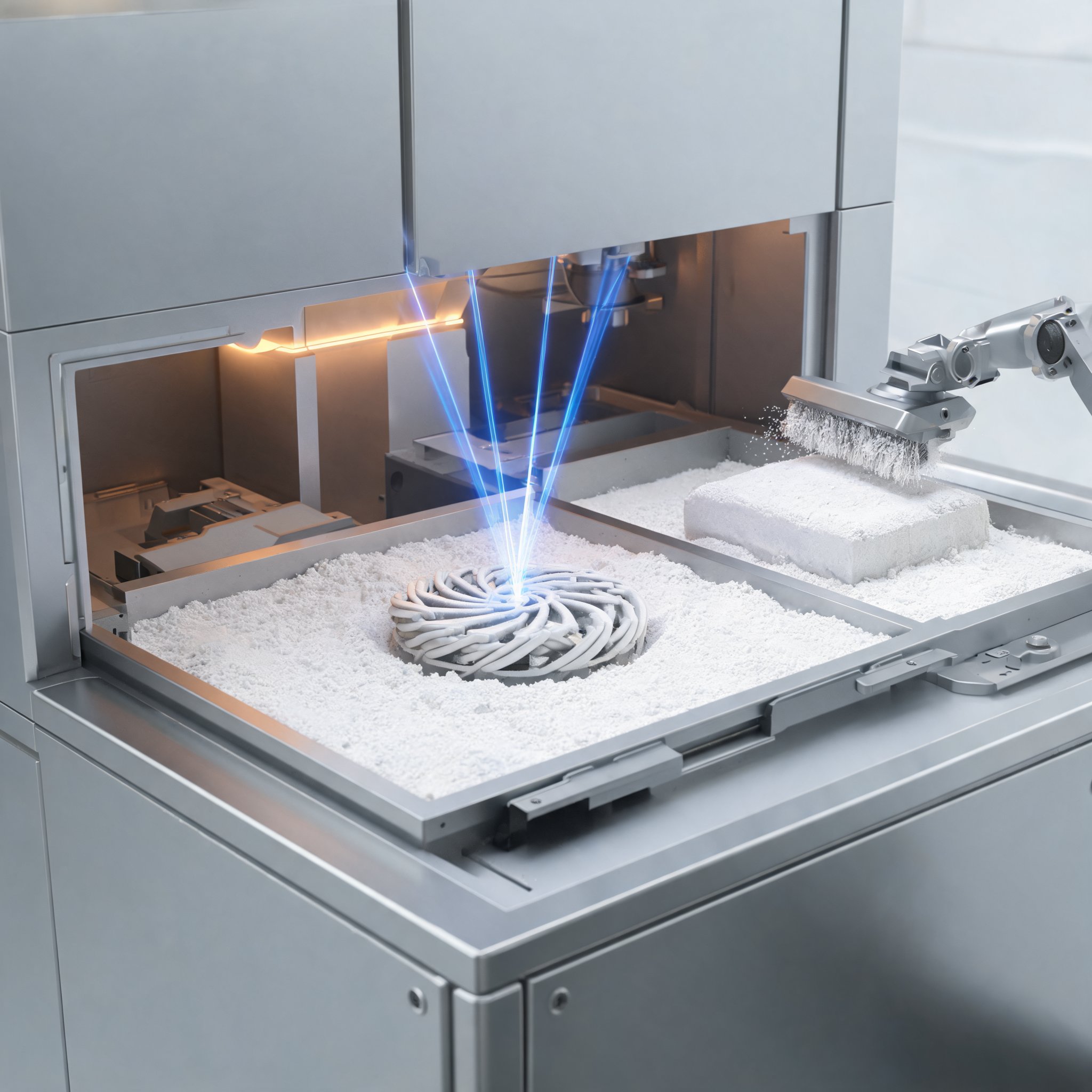
Materialise has completed a production-condition evaluation of an unreleased EOS polymer 3D printing platform and reported a 44% productivity increase compared with the previous EOS system. The additive manufacturing service provider also measured a per-part build time reduction of more than six minutes, with the cable twist wheel it produced for GKN Aerospace taking 13 minutes 51 seconds instead of 19 minutes 53 seconds.
Production trial goes beyond printability
The trial was not limited to whether the machine could print the GKN Aerospace part; it could. Materialise also assessed reliability, the effect of the platform's new features, productivity and efficiency, usability and control, and the ease of post-processing. EOS has not released full technical details and is scheduled to present the platform at Formnext 2026 on Nov. 17. Materialise's results therefore describe an early customer evaluation, not a commercially available system, and provide an early view of production potential while key specifications remain undisclosed.
Three lasers, load balancing and open controls
According to the information available, the platform uses a three-laser architecture with intelligent utilization and dynamic load balancing. The load-balancing function is intended to maximize output per build by distributing exposure work evenly, while the added laser capacity is linked to higher productivity. Giovanni Vleminckx, process engineering manager at Materialise, said the three lasers make a visible performance difference and that their intelligent use supports higher throughput while maintaining the part quality customers expect.
The system also offers extended process controls. Users can work with validated parameter sets or open them up for more control and alignment with specific applications and key performance indicators. Vleminckx said the overall performance of the system stood out, rather than a single feature, combining the productivity needed with the process stability and control required for demanding production applications.
Downstream gains from softer powder cakes
Materialise also observed benefits after printing. An advanced roller recoater produces softer powder cakes, which makes depowdering easier and reduces handling effort. Vleminckx described the soft powder cake as a tangible improvement for operators, adding that parts are easier to unpack and depowder and that the overall workflow is noticeably more efficient. For a manufacturing service with high-throughput requirements and a need to adapt to different production applications, those gains sit alongside the headline productivity increase.
EOS plans to show the polymer platform in person from Nov. 17 at Formnext 2026 at its booth in hall 12, stand D71. Until then, the available performance figures remain tied to Materialise's evaluation of the upcoming system.