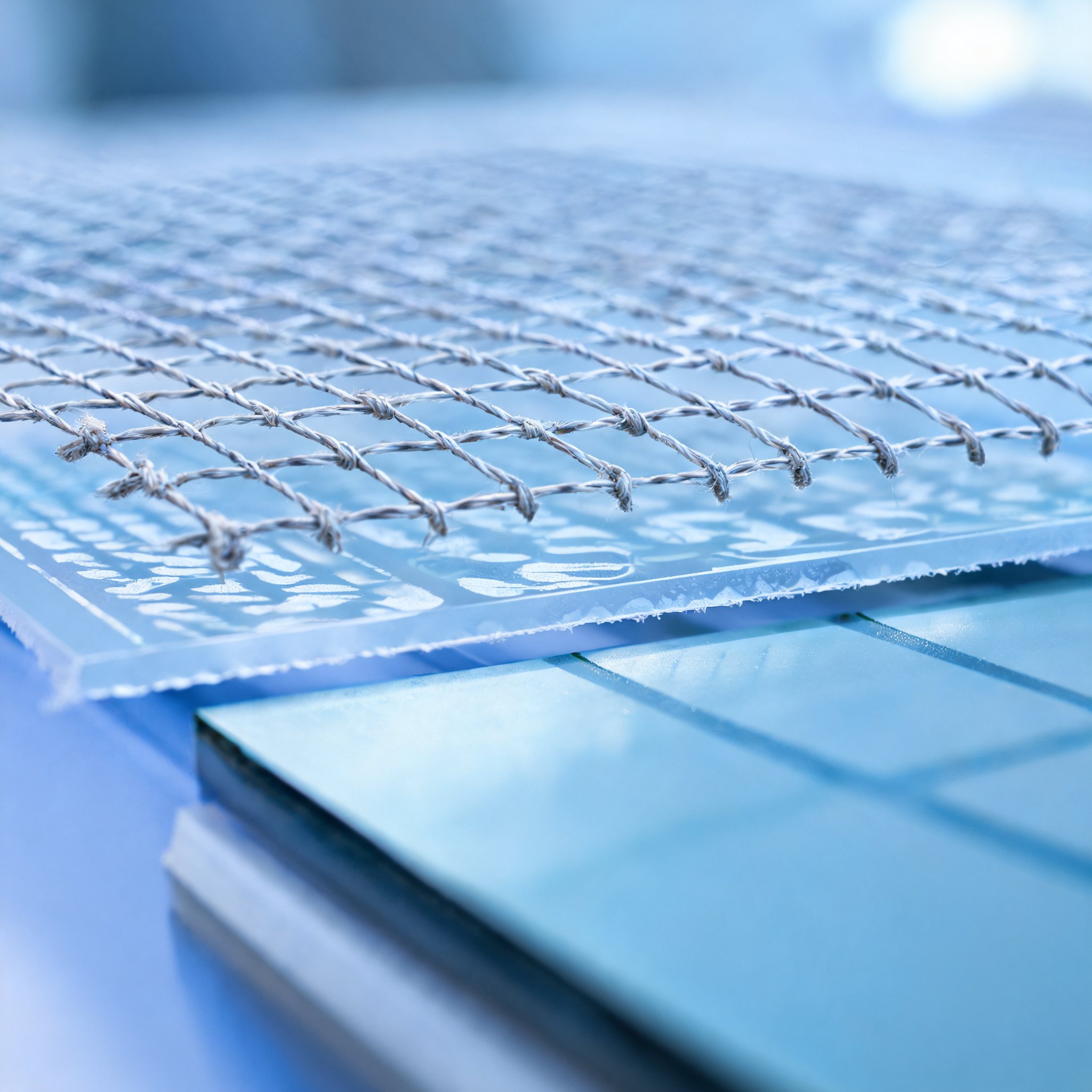
Researchers in China have identified progressive wear of screen mesh knuckles as a main cause of screen-printing-induced degradation in copper-plated silicon heterojunction (HJT) solar cells and proposed an emulsion buffer layer to reduce it.
Screen printing is widely used in solar cell metallization, but in HJT cells the process can damage sensitive passivating contact structures. Mechanical pressure and thermal treatments can increase recombination losses and lower conversion efficiency. For copper-plated HJT, which aims to cut metallization costs and reliance on expensive silver, controlling that damage matters for large-scale manufacturing.
Why photoresist printing is different
Lang Zhou, the corresponding author, said photoresist screen printing differs fundamentally from conventional silver paste printing. Silver paste screens have openings covering only 2–5% of the total area, with an emulsion layer protecting the rest and preventing direct mesh-wafer contact. Full-area photoresist coating typically uses a screen without emulsion coverage to ensure uniform resist deposition, so the mesh contacts the wafer extensively during every printing cycle.
Measured degradation
Earlier production data cited by the researchers showed conversion efficiency falling from 26.2% to 25.7% over 15,000 consecutive printing cycles. Reductions in open-circuit voltage and fill factor accounted for most of the loss, while short-circuit current density and electrical resistance remained largely unchanged. Minority carrier lifetime degradation rose from 0.61% with a new screen to 11.0% after 15,000 cycles.
Using three-dimensional confocal microscopy, the team linked the decline to progressive wear of the mesh knuckles. As knuckles wore down, their contact area with the wafer increased, raising mechanical stress on the underlying passivation layers. Scanning electron microscopy showed no visible surface scratches, but photoluminescence measurements indicated increased recombination losses, suggesting damage at the amorphous silicon/crystalline silicon interface.
Emulsion buffer trade-off
The researchers tested an emulsion buffer layer to keep the mesh from touching the wafer, evaluating six patterns with emulsion coverage ratios from 2.9% to 16.6%. Higher coverage reduced mechanical damage but impaired photoresist coating uniformity and ink distribution.
A 4.7% coverage ratio gave the best balance in their tests, limiting minority carrier lifetime degradation to 0.41% after 10,000 printing cycles while maintaining relatively good coating uniformity. The team attributed the improvement to reduced cumulative mechanical damage to the passivation layers.
Zhou said the findings show that a relatively simple modification to screen design can substantially mitigate printing-induced degradation, offering a practical approach to improving manufacturing reliability for copper-plated HJT cells. The work was published in the journal Solar Energy.
The result arrives as copper metallization attracts growing interest as an alternative to silver contacts. In April 2026, researchers at China’s Nankai University reported a silver-free HJT cell at 25.2% efficiency using plasma-induced interface engineering and copper electroplating, addressing adhesion, contact resistance and stability challenges at the ITO interface. Separately, Germany’s Forschungszentrum Jülich reported 23.08% efficiency for a fully copper-metallized HJT cell, with a relatively small penalty versus its silver-metallized counterpart; cells combining silver-copper paste on the front with silver contacts on the rear reached 23.95%. Those results underline copper’s potential to reduce silver use, while further improvements in processing and electrical performance remain necessary.